
Published By Mike Damiano Globe Staff
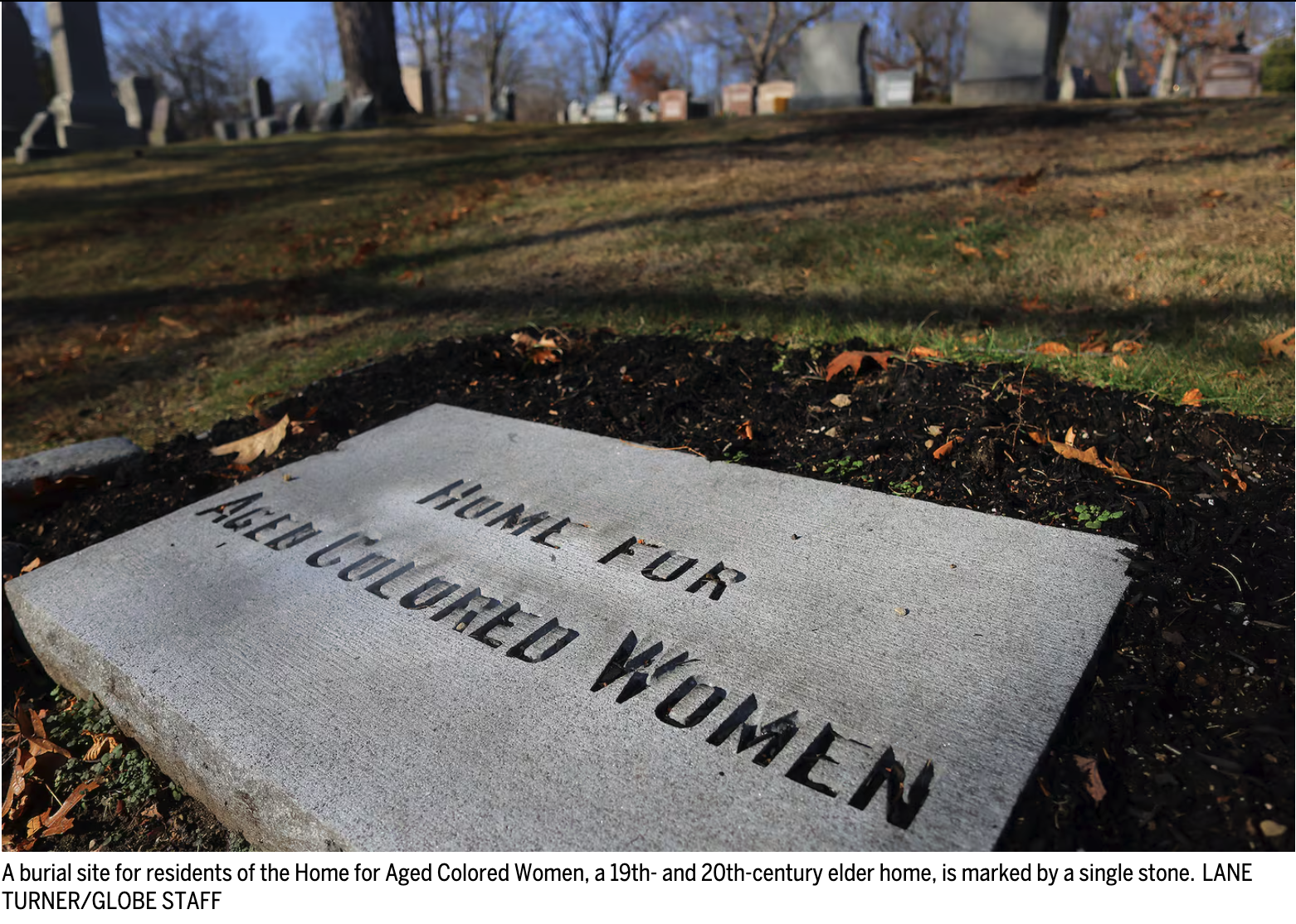
At the Cedar Grove Cemetery in Dorchester, there are two burial sections side by side for deceased residents of Beacon Hill homes for “aged women”: one for elderly white women and one for elderly Black women.
But there is a striking difference between them. For every grave of a white woman, there is a headstone bearing her name. The graves of the Black women are unmarked.
This inequality has persisted for more than 150 years, since the Home for Aged Colored Women began burying its residents at Cedar Grove in 1873. Now, a group of neighbors, former city officials, and nonprofit leaders are trying to fix it.
On Wednesday evening, an art installation was unveiled at the site and the names of the 133 women known to have been buried there were read off during a ceremony. Eventually, the group plans to install permanent memorials with the women’s names.
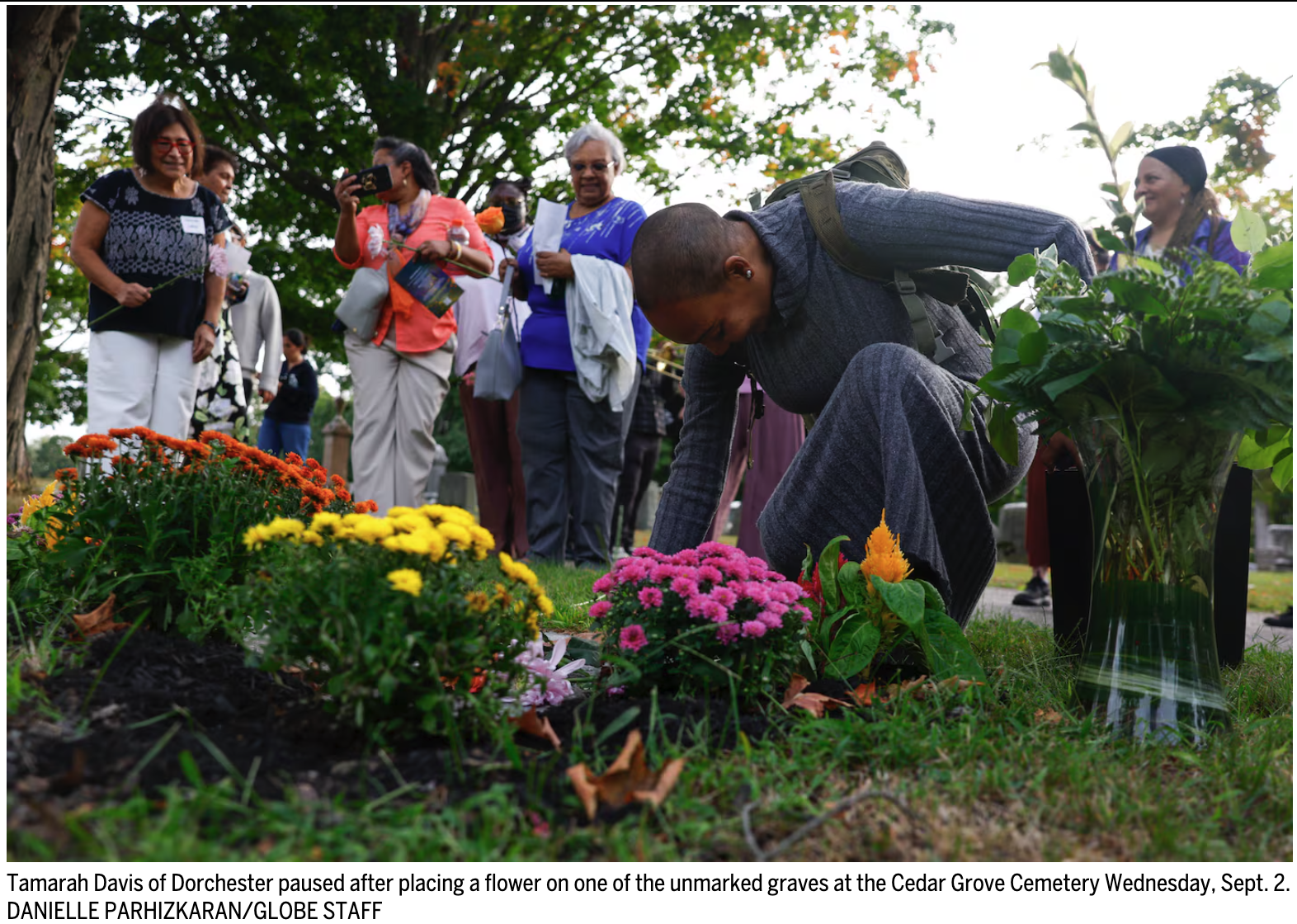
Nearly 100 people filled the pews of the cemetery’s chapel, as violinist Adrian Anantawan
performed as they arrived for the 5 p.m. ceremony.
“We cannot change the circumstances of the burial, but we can change what happens
now,” said Diana Lam, president of the Boston Women’s Heritage Trail. “We can speak
their names, we can honor their lives, we can tell their stories, and we can ensure the
future generations know that these women were here.”
The project began when Joyce Linehan, a former aide to ex-Boston mayor Martin J.
Walsh who lives in Dorchester, walked her dog past the burial site and noticed it was
marked only by a stone inscribed with the name of the Home for Aged Colored Women.
She wondered who was buried there and started asking questions.
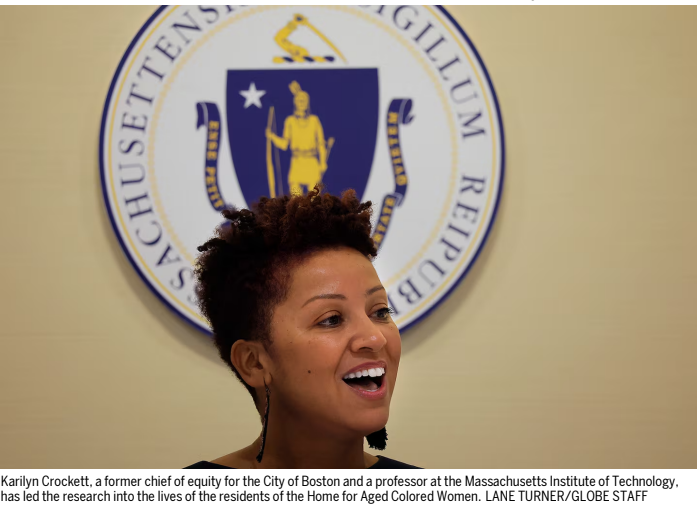
Linehan’s friend Karilyn Crockett, also a former city official and a professor at MIT, then
launched a multiyear research project that led to the discovery of the buried women’s
names and shed light on a mostly forgotten chapter of the city’s history.
“These women were building a city for us and with us at a time [when] they were not
given credit or recognition for that at all,” Crockett said.
The women lived in a segregated elder home on Beacon Hill between 1860 and 1944.
They were domestic servants and suffrage activists. They were congregants at Twelfth
Baptist, then known as the Fugitive Slave Church. Some had been born into Southern
slavery and moved north after the Civil War.
They were not welcome at the nearby Home for Aged Women, where the residents were
white and mostly Protestant. The homes were only a few blocks apart. Their burial sites
were even closer — literally adjacent plots at Cedar Grove. But only one had headstones.
The residents of the Home for Aged Colored Women were buried, and then their names
— or at least their burial sites — were largely forgotten.
In 2024, Rita Steele, a data analytics professional and avid genealogist, was trying to
trace her family tree to its Native American roots. She thought her fourth great-
grandmother, Sarah Smith, who died in Boston in 1890, might provide the link.
“So I used one of my successful research strategies (reverse address search) of the
address on her death certificate,” Steele said by text message. She assumed the Beacon
Hill address was a family home. But instead, “it came back with the name for the Home
for Aged Colored Women.”
That discovery led her to a blog post by Linehan about the Dorchester burial site. She got
in touch with Linehan and Crockett and has been involved in planning the memorial ever
since.
Joyce Linehan, a former chief of policy and planning for former mayor Martin J. Walsh, lives beside Cedar Grove Cemetery,
where her parents are buried. LANE TURNER/GLOBE STAFF
Crockett’s research has proceeded on a parallel track. After learning of the burial site
from Linehan, she assigned her MIT graduate students to research the home. The
cemetery had handwritten note cards listing the women’s names in its archives. Then
they found the home’s records in the archives of the Massachusetts Historical Society.
What emerged was an unusually intimate portrait of the women’s lives. The records
showed “who was an avid reader, who was a vegetarian, who didn’t like who,” Linehan
said. “There was gossipy stuff in there.”
For Crockett, the research also challenged the assumption that Black Bostonians,
especially elderly Black women, must have been isolated, only marginal participants in
the life of the city. Eliza Gardner, who received financial assistance from the home, was a
prominent public speaker and member of Black political organizations, Crockett said.
She was once featured in The Woman’s Era, a newspaper founded in Boston in 1894.
Other women were part of migrations to New England. Some came from Canada, others
from the American South.
Annie B. Merrick was born into slavery in North Carolina in 1848, according to Crockett.
She moved north and then lived in the Home for Aged Colored Women beginning in
1923. She died at Boston State Hospital in 1941.
Left: A 1900 census showing residents of The Home for Aged Colored Women in green, including Annie Merrick (highlighted in
yellow), who was born into enslavement in North Carolina in 1848. Center: Eliza Gardner was a religious leader and community
activist. She died in the Home for Aged Colored Women on Jan. 4, 1922, at 90 years old. Right: Administrative records from Jan.
12, 1937. GLOBE STAFF/US CENSUS/HANDOUTS
Smith, Steele’s ancestor, was born in Newport, R.I., around 1799. Her father had been
enslaved and fought in the Revolutionary War. Two of Smith’s brothers were abolitionists
who worked with Frederick Douglass. Steele and Crockett are still trying to learn more
about Smith herself.
Steele traveled from her home in Maryland to attend the ceremony. “There’s tons of work
to be done,” she said. “I hope this is a flicker of light for someone.”
The women, including her ancestor, Smith, are buried in two plots — the one next to the
white women’s burial ground and a second one that was used when the first filled up.
The temporary memorial is a “collage” of flowers and women’s portraits formed into a
single figure to “reflect both the individuality of each woman and her presence in a
greater community,” artist Ekua Holmes said.
The Roxbury-born artist entered the chapel to applause. She drew inspiration from Ellis
Wilson’s “Funeral Procession” painting, she said.
The installation will remain there for a year while the nonprofit Boston Women’s
Heritage Trail raises money for a permanent memorial that includes all of the women’s
names.
Roxbury artist Ekua Holmes unveiled the temporary memorial art at the chapel of the Cedar Grove Cemetery. DANIELLE
PARHIZKARAN/GLOBE STAFF
Robert MacEachern, who runs the cemetery, estimates the memorial will cost more than
$100,000. The past two state budgets earmarked $45,000 combined for the project. A
grant from the city of Boston paid for Holmes’s work but is not funding the permanent
memorial.
When Steele first learned of Smith’s burial place, she found the circumstances “very
disturbing and disappointing.”
“No one knew who they were walking by,” she said. “Like they didn’t mean anything to
anyone. . . . But I am so proud that their names are finally being restored.”
Correspondent Madyline Swearing contributed to this story.
Mike Damiano can be reached at mike.damiano@globe.com.
Show 28 comments
Cedar Grove Cemetery in 2016. LANE TURNER/GLOBE STAFF